Let's Build a Print-Ready Die-Cut Sticker SaaS from scratch in Golang & Next.js [Part 5]

Karan Kashyap
July 3, 2026
![Let's Build a Print-Ready Die-Cut Sticker SaaS from scratch in Golang & Next.js [Part 5]](/_next/image/?url=https%3A%2F%2Fcdn.sanity.io%2Fimages%2F3e1sexdu%2Fproduction%2Feeb1314f51d4c39e5d1e176c2c837de8f33725ca-1600x739.png%3Frect%3D246%2C0%2C1109%2C739%26w%3D1200%26h%3D800%26q%3D85%26fit%3Dcrop%26auto%3Dformat&w=3840&q=75)
Part 5: The Async Pipeline & Real-Time Status
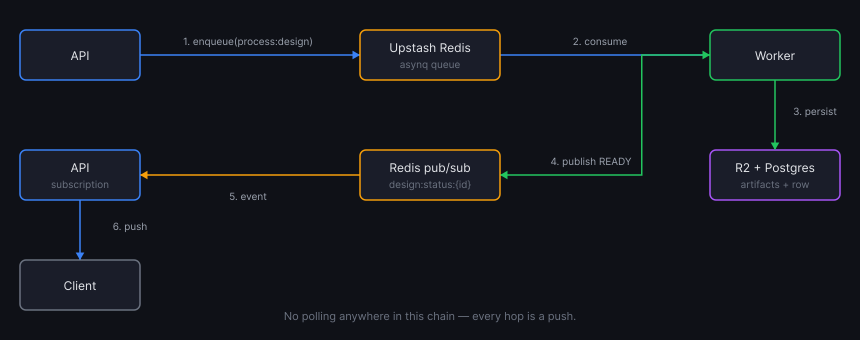
createDesign returns in milliseconds. The actual work — downloading a multi-megabyte image, running it through background removal and contour tracing, rendering mockups, writing results back — takes seconds, sometimes most of a second per stage. Making the client wait on an HTTP response for that would mean holding a connection open across a Cloud Run instance that might scale to zero mid-request. Instead, the API hands a job to a queue and gets out of the way, and the client finds out what happened by subscribing to a channel, not by polling.
This part covers both halves of that: the durable queue connecting API and worker, and the pub/sub bridge that turns a worker's progress into a live GraphQL subscription.
The shared job contract
Both services/api (which enqueues) and services/worker (which consumes) need to agree on exactly what a job looks like, so that contract lives in its own module, imported by both:
1// packages/jobs/jobs.go2type ProcessDesignPayload struct {3 DesignID uuid.UUID `json:"design_id"`4 UserID string `json:"user_id"`5 SourceKey string `json:"source_key"`6 ContourOpts ContourOptions `json:"contour_opts"`7 PhysicalWMm float64 `json:"physical_w_mm,omitempty"`8 PhysicalHMm float64 `json:"physical_h_mm,omitempty"`9 AttemptNumber int `json:"attempt_number"`10 EnqueuedAt time.Time `json:"enqueued_at"`11}1213const (14 TypeProcessDesign = "process:design"15 TypeReprocessDesign = "reprocess:design"16 MaxRetries = 517)
The queue itself is asynq running against Upstash Redis — Redis was already a project dependency for rate limiting, so the job queue doesn't add a new moving part, just a new use for one that's already there.
Deduplication that doesn't over-collapse
A naive dedup key of just "this design" would break reprocessDesign — a legitimate request to re-run with a different contour offset would silently no-op if it collided with an in-flight job for the same design. The fix is scoping the key to the design and the specific options being requested:
1// packages/jobs/jobs.go2func dedupKey(taskType string, designID uuid.UUID, opts ContourOptions) string {3 optsData, _ := json.Marshal(opts)4 hash := md5.Sum(append([]byte(taskType+designID.String()), optsData...))5 return fmt.Sprintf("%x", hash)6}78func NewProcessTask(payload ProcessDesignPayload) (*asynq.Task, error) {9 data, _ := json.Marshal(payload)10 return asynq.NewTask(11 TypeProcessDesign, data,12 asynq.MaxRetry(MaxRetries),13 asynq.Queue(DefaultQueue),14 asynq.TaskID(dedupKey(TypeProcessDesign, payload.DesignID, payload.ContourOpts)),15 ), nil16}
Two accidental double-clicks on "upload" for the same design with the same options collapse into one job. A reprocessDesign call with a wider border offset gets its own task ID and runs independently — same design, different key.
Enqueueing: the API's half of the handoff
createDesign builds the payload and hands it to an asynq client; from the resolver's point of view, enqueueing is fire-and-forget — a failure here gets logged, not surfaced as an error, because the design row already exists and can always be reprocessed:
1// services/api/graph/resolver/schema.resolvers.go2task, taskErr := jobs.NewProcessTask(jobs.ProcessDesignPayload{3 DesignID: design.ID,4 UserID: user.ClerkID,5 SourceKey: input.StorageKey,6 ContourOpts: contourOpts,7 PhysicalWMm: physW,8 PhysicalHMm: physH64,9 EnqueuedAt: time.Now(),10})11if taskErr == nil {12 if _, enqErr := r.JobQueue.EnqueueContext(ctx, task); enqErr != nil {13 log.Printf("WARN: enqueue job for design %s: %v", design.ID, enqErr)14 }15}
Right after enqueueing, the resolver flips designs.status to PROCESSING — the row reflects "a job exists for this" immediately, well before the worker has even picked it up.
Consuming: the worker's half
The worker registers one handler for both task types — process:design and reprocess:design run through the same pipeline, since a reprocess is just a process run with different options on an existing design:
1// services/worker/main.go2srv, err := jobs.NewAsynqServer(5) // max 5 concurrent heavy jobs3mux := asynq.NewServeMux()4mux.HandleFunc(jobs.TypeProcessDesign, handleProcessDesign)5mux.HandleFunc(jobs.TypeReprocessDesign, handleProcessDesign)6srv.Run(mux)
The concurrency cap of 5 is a deliberate ceiling, not a tuning afterthought — the imaging pipeline from Part 4 is CPU-heavy per job, and a Cloud Run instance running twenty of these at once would thrash rather than finish any of them faster. If REDIS_URL isn't set at all, the worker still boots and blocks forever in a standalone no-queue mode, rather than crash-looping — useful for confirming the binary builds and starts without needing Redis available.
The pipeline: download, process, upload, repeat
pipeline.Run is the glue between the queue and core-imaging — download the original from R2, decode it, hand it to Process, then upload every artifact the result produced:
1// services/worker/internal/pipeline/pipeline.go2func Run(ctx context.Context, payload *jobs.ProcessDesignPayload) (*Result, error) {3 imgBytes, err := downloadObject(ctx, s3Client, cfg.Bucket, payload.SourceKey)4 img, err := decodeImage(imgBytes)56 opts := coreimaging.DefaultOptions()7 // ...apply payload.ContourOpts, PhysicalWMm/HMm8 pResult, err := coreimaging.Process(img, opts)910 // cutout PNG → cutouts/{id}.png11 // contour SVG → contours/{id}.svg12 // print export → exports/{id}.svg13 mockupURLs, _ := renderAndUploadMockups(ctx, s3Client, cfg, designID, pResult.Cutout)1415 return &Result{CutoutURL: ..., MockupURLs: mockupURLs, Confidence: pResult.Meta.Confidence, ...}, nil16}
Mockups get composited server-side too — the cutout scaled to 60% of a scene and centered over a solid background — so the public storefront page (Part 6) has stable images that don't depend on a client re-rendering anything. A mockup render failure is logged and treated as non-fatal; a design without mockups still ends up READY, it just has an empty mockupUrls list.
Status changes go through Redis, not the database, in the hot path
When a job finishes, the worker writes the result to Postgres and also publishes a small event to a Redis channel keyed by design ID:
1// services/worker/main.go2func publishStatus(ctx context.Context, designID, status, cutoutURL string) {3 redisURL := os.Getenv("REDIS_URL")4 if redisURL == "" {5 return6 }7 rdb := redis.NewClient(opts)8 data, _ := json.Marshal(statusEvent{DesignID: designID, Status: status, CutoutURL: cutoutURL})9 rdb.Publish(ctx, "design:status:"+designID, data)10}
On the API side, the same dev/prod-symmetry pattern from Part 2's auth story shows up again: a pubsub.Bus interface has two implementations, a real Redis client and an in-memory fan-out bus, and the constructor picks based on whether REDIS_URL is set:
1// services/api/internal/pubsub/pubsub.go2func NewBus() (Bus, error) {3 rc, err := NewRedisClient()4 if err != nil {5 return nil, err6 }7 if rc == nil {8 log.Println("[pubsub] REDIS_URL not set — using in-memory bus (dev mode)")9 return NewInMemoryBus(), nil10 }11 return rc, nil12}
Locally, with no Redis running at all, subscriptions still work end-to-end through the in-memory bus — a single-process pub/sub map guarded by a mutex. In production, Redis is what lets the API and worker be two separate, independently-scaled processes that still talk to each other in real time.
The subscription resolver bridges the channel to GraphQL
designStatus(id) subscribes to the bus and re-fetches the full Design row from Postgres on every event, rather than trusting the event payload to carry every field the client might need:
1// services/api/graph/resolver/schema.resolvers.go2func (r *subscriptionResolver) DesignStatus(ctx context.Context, id string) (<-chan *model.Design, error) {3 events, err := r.PubSub.Subscribe(ctx, id)4 ch := make(chan *model.Design, 8)5 go func() {6 defer close(ch)7 for {8 select {9 case <-ctx.Done():10 return11 case event, ok := <-events:12 if !ok {13 return14 }15 d, _ := r.Queries.GetDesignByID(ctx, designID)16 ch <- dbDesignToModel(d)17 }18 }19 }()20 return ch, nil21}
That re-fetch is deliberate: the pub/sub event only carries design_id, status, and maybe a cutout_url — it's a doorbell, not a payload. The subscription stays cheap to publish (small JSON message) and the client always gets a fully-formed Design, not a partial one assembled from whatever happened to be in the event.
The whole round trip
Verify it
1# terminal 12cd services/worker && go run .3# terminal 24cd services/api && go run .
1subscription {2 designStatus(id: "your-design-id") {3 status4 cutoutUrl5 readiness { dpi { status } }6 }7}
Open the subscription in the playground before triggering createDesign — the design should flip from PROCESSING to READY (or FAILED) on the open socket within a second or two of the worker log printing "done", with no refresh and no re-query needed.
With results landing in real time, there's finally a UI worth building around them.
Next up — Part 6: the Studio and storefront in Next.js — the create flow, live status, readiness badges, and semantic search over published designs.






![Let's Build a Print-Ready Die-Cut Sticker SaaS from scratch in Golang & Next.js [Part 6]](/_next/image/?url=https%3A%2F%2Fcdn.sanity.io%2Fimages%2F3e1sexdu%2Fproduction%2Feeb1314f51d4c39e5d1e176c2c837de8f33725ca-1600x739.png%3Frect%3D61%2C0%2C1478%2C739%26w%3D800%26h%3D400%26q%3D85%26fit%3Dcrop%26auto%3Dformat&w=3840&q=75)