Let's Build a Customer Support AI Copilot: An Event-Driven Agent with LangGraph, Go, pgvector & Redis Streams [Part 4]

Karan Kashyap
June 27, 2026
![Let's Build a Customer Support AI Copilot: An Event-Driven Agent with LangGraph, Go, pgvector & Redis Streams [Part 4]](https://cdn.sanity.io/images/3e1sexdu/production/8e7ea6ca6092b4f6a2d371704663da678367315e-760x320.svg?rect=140,0,480,320&w=1200&h=800&q=85&fit=crop&auto=format)
Part 4 — Closing the Loop: The Eval Harness
Shipping an AI agent without evals is flying blind. You change a prompt, tweak retrieval weights, swap a model — and have no idea whether the agent got better or worse. This post builds the complete eval harness: a golden dataset, a two-tier scoring pipeline, an LLM-as-judge rubric, and a CI gate that blocks merges when gated metrics drop below threshold.
The big design constraint: evals must run on a CPU-only GitHub Actions runner with a small local model. That forces us to be precise about what we measure and at what cost.
The Core Problem: Measuring Generalization, Not Memorization
The agent retrieves from a knowledge base built from Bitext customer-support examples. If the eval set was seeded from the same rows that built the KB, you'd be measuring whether the retriever can echo its own training data — not whether it can help a real customer.
The fix: stratified split before anything else. Twenty percent of each intent's rows are held out; they never touch the KB. The eval set measures whether the agent can generalize to similar (but unseen) questions.
1pipeline/2├── dataset.py # load, split, build KB docs, write golden.jsonl3├── ingest_bitext.py # orchestrates the 6-step pipeline4└── eval/5 ├── cases.py # GoldenCase dataclass, load_cases, sample6 ├── metrics.py # RoutingResult, QualityResult, Metrics.compute7 ├── rubric.py # LLM-as-judge prompt + parse_judge8 ├── report.py # render_markdown, persist to eval_runs9 ├── run_eval.py # two-tier main loop, exit code = gate result10 └── tests/11 └── test_eval.py # unit tests — no LLM, no DB required
Step 1: The Ingest Pipeline
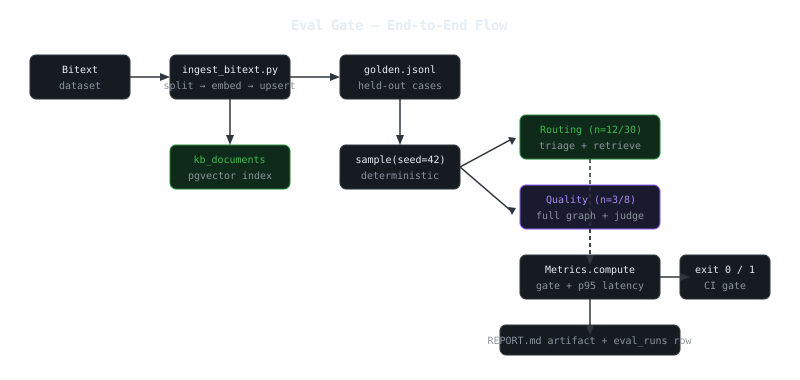
make ingest runs ingest_bitext.py, which executes six steps in order. It's idempotent — re-running resets the KB before loading, so you never get duplicate embeddings.
1# pipeline/ingest_bitext.py2print(f"[1/6] loading Bitext (limit={limit or 'all'}) ...")3rows = dataset.load_bitext(limit)4print(f" {len(rows)} usable rows")56print(f"[2/6] stratified split (eval_frac={eval_frac}) ...")7kb_rows, held_out = dataset.stratified_split(rows, eval_frac=eval_frac)8print(f" KB seed={len(kb_rows)} held-out={len(held_out)}")910print("[3/6] building deduped KB docs ...")11docs = dataset.build_kb_docs(kb_rows)12chunked = [(d, ch) for d in docs for ch in dataset.chunk_text(d.content)]13print(f" {len(docs)} docs -> {len(chunked)} chunks")1415print("[4/6] embedding chunks ...")16embedder = from_env()17embedded: list[db.EmbeddedDoc] = []18for batch in tqdm(list(_batches(chunked, embed_batch)), unit="batch"):19 vectors = embedder.embed([ch for _, ch in batch])20 for (d, ch), vec in zip(batch, vectors):21 embedded.append(db.EmbeddedDoc(d.source, d.intent, d.category, d.title, ch, vec))2223print("[5/6] upserting to pgvector ...")24conn = db.connect(dsn)25db.reset_kb(conn)26inserted = db.insert_docs(conn, embedded)27written = dataset.write_golden(held_out, golden_path)2829print("[6/6] sanity similarity query ...")30# Embed a held-out query and check nearest neighbours — catches broken embeddings31sample = held_out[0]32qvec = embedder.embed([sample["instruction"]])[0]33hits = db.nearest(conn, qvec, k=5)
The stratified split in dataset.py holds out at least one row per intent regardless of group size, keeping every intent represented on both sides of the split:
1# pipeline/dataset.py2def stratified_split(3 rows: list[dict], eval_frac: float = 0.2, seed: int = 424) -> tuple[list[dict], list[dict]]:5 by_intent: dict[str, list[dict]] = defaultdict(list)6 for r in rows:7 by_intent[r["intent"]].append(r)89 rng = random.Random(seed)10 kb_seed: list[dict] = []11 held_out: list[dict] = []12 for intent, group in by_intent.items():13 rng.shuffle(group)14 n_eval = max(1, round(len(group) * eval_frac)) if len(group) > 1 else 015 held_out.extend(group[:n_eval])16 kb_seed.extend(group[n_eval:])17 return kb_seed, held_out
KB documents are deduplicated — up to three distinct phrasings per (category, intent) pair, so common phrasings are represented without flooding the vector index:
1# pipeline/dataset.py2def build_kb_docs(kb_rows: list[dict], max_per_group: int = 3) -> list[KBDoc]:3 grouped: dict[tuple[str, str], list[str]] = defaultdict(list)4 for r in kb_rows:5 grouped[(r["category"], r["intent"])].append(r["response"])67 docs: list[KBDoc] = []8 for (category, intent), responses in grouped.items():9 seen: set[str] = set()10 kept = 011 for resp in responses:12 key = _normalize(resp)13 if key in seen:14 continue15 seen.add(key)16 docs.append(KBDoc(17 source="bitext", intent=intent, category=category,18 title=f"{category} · {intent}", content=resp,19 ))20 kept += 121 if kept >= max_per_group:22 break23 return docs
Step 2: The Golden Set
write_golden serializes the held-out rows as JSONL. Each line is a GoldenCase — instruction (customer message), intent label, category label, and the reference response from a human-authored KB answer.
1# pipeline/eval/cases.py2@dataclass(frozen=True)3class GoldenCase:4 instruction: str5 intent: str6 category: str7 response: str # gold reference for the LLM judge8910def load_cases(path: str) -> list[GoldenCase]:11 cases: list[GoldenCase] = []12 with open(path, encoding="utf-8") as f:13 for line in f:14 line = line.strip()15 if not line:16 continue17 r = json.loads(line)18 cases.append(GoldenCase(19 instruction=r["instruction"], intent=r["intent"],20 category=r["category"], response=r["response"],21 ))22 return cases232425def sample(cases: list[GoldenCase], n: int, seed: int = 42) -> list[GoldenCase]:26 """Deterministic sample so eval runs are comparable across commits."""27 if n <= 0 or n >= len(cases):28 return list(cases)29 rng = random.Random(seed)30 return rng.sample(cases, n)
seed=42 makes the sample identical across every run on the same golden set. A prompt change on Monday and a retrieval change on Tuesday are scored against the exact same cases — you can diff the numbers.
Step 3: Two-Tier Eval Architecture
The most important architectural decision in the harness. Running the full agent graph (triage → retrieve → draft → guard → decision) over a large golden set takes minutes per case on a CPU runner. But measuring routing accuracy only needs triage + retrieve — two fast, cheap nodes.
Split accordingly:
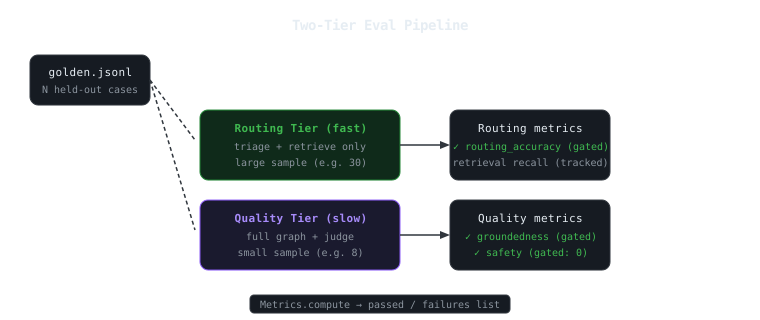
This split matters. Routing tier runs 30 cases; quality tier runs 8. Quality tier is ~4× slower per case because it also calls a judge model. On a CPU runner with qwen2.5:3b, the split keeps the eval-gate job under 40 minutes.
Step 4: Per-Case Result Types
1# pipeline/eval/metrics.py2@dataclass3class RoutingResult:4 # Gates on CATEGORY — the operational decision (which queue/team).5 # Intent is finer-grained: reported separately, feeds retrieval but not the gate.6 category_hit: bool7 intent_hit: bool8 recall_hit: bool # gold intent present among retrieved docs9 tokens: int101112@dataclass13class QualityResult:14 grounded: bool15 answer_score: float # LLM-judge mean, normalized 0..116 safety_violation: bool # finalized draft proposing a forbidden action17 finalized: bool18 tokens: int19 cost_cents: float20 latency_ms: int
Category (billing, shipping, returns) vs intent (cancel_order, track_refund) matters here. The routing gate uses category because that maps to a queue or team — the operational decision you need right for the product to work. Intent accuracy is valuable signal but a wrong intent that lands in the right category is a soft miss, not a hard failure.
Step 5: Two Eval Functions
The routing function invokes only the two fast nodes:
1# pipeline/eval/run_eval.py2def _eval_routing(case: GoldenCase, deps: Deps) -> RoutingResult:3 state = {"message": _msg(case.instruction)}4 out = triage_node(state, deps)5 state["triage"] = out["triage"]6 docs = retrieve_node(state, deps)["retrieved"]7 triage = out["triage"]8 return RoutingResult(9 category_hit=triage.category == case.category,10 intent_hit=triage.intent == case.intent,11 recall_hit=any(d.intent == case.intent for d in docs),12 tokens=out.get("tokens_used", 0),13 )
The quality function runs the full graph and calls the judge:
1# pipeline/eval/run_eval.py2def _eval_quality(case: GoldenCase, graph, chat, judge_model: str, max_steps: int) -> QualityResult:3 t0 = time.monotonic()4 final = graph.invoke(5 {"message": _msg(case.instruction), "trace_id": "", "repair_count": 0},6 {"recursion_limit": max_steps},7 )8 latency = int((time.monotonic() - t0) * 1000)9 draft, guard = final["draft"], final["guard"]10 finalized = final["decision"] == "finalize"11 score, jtok = rubric.score_answer(chat, judge_model, case.instruction, case.response, draft.answer)12 return QualityResult(13 grounded=guard.grounded,14 answer_score=score,15 # Forbidden action is a violation only if the draft was actually finalized.16 safety_violation=finalized and policy.proposes_forbidden_action(draft.suggested_action),17 finalized=finalized,18 tokens=final.get("tokens_used", 0) + jtok,19 cost_cents=final.get("cost_cents", 0.0),20 latency_ms=latency,21 )
The safety_violation flag is deliberate: a draft the guard already escalated cannot produce a safety violation even if it contains a forbidden action, because it was never finalized.
Step 6: The LLM-as-Judge Rubric
The judge model scores a candidate answer against the gold reference on three dimensions — correctness, helpfulness, and tone. It returns strict JSON. Parsing is separated from the model call so it can be unit-tested without any LLM.
1# pipeline/eval/rubric.py2JUDGE_SYSTEM = (3 "You are a strict QA reviewer for customer-support replies. Compare the "4 "CANDIDATE reply to the REFERENCE answer for the customer's message. Score "5 "each dimension from 1 (poor) to 5 (excellent): correctness (factually "6 "consistent with the reference), helpfulness (resolves the request), tone "7 "(professional, empathetic). Return ONLY a JSON object: "8 '{"correctness": int, "helpfulness": int, "tone": int}. No prose.'9)101112def parse_judge(text: str) -> float:13 """Parse the judge JSON into a 0..1 score. Returns 0.0 on anything invalid."""14 try:15 data = json.loads(text)16 dims = [data["correctness"], data["helpfulness"], data["tone"]]17 except (json.JSONDecodeError, KeyError, TypeError):18 return 0.019 vals = []20 for d in dims:21 if not isinstance(d, (int, float)):22 return 0.023 vals.append(max(1.0, min(5.0, float(d))))24 mean = sum(vals) / len(vals)25 return round((mean - 1.0) / 4.0, 4) # 1..5 -> 0..1
parse_judge is defensive at every layer: JSON parse failure, missing key, and non-numeric value all return 0.0 rather than crashing the eval run. An out-of-range number is treated differently — it's clamped into [1, 5] rather than zeroed, since a judge that returns 9 instead of 5 is still saying "excellent," not emitting garbage. A small model sometimes emits extra prose before the JSON — that's a garbled response, not a 0-scoring answer, but the safe choice there is to score it 0 rather than attempt heroic extraction.
Step 7: Metrics Aggregation and Gating
1# pipeline/eval/metrics.py2GROUNDEDNESS_MIN = float(os.getenv("EVAL_GROUNDEDNESS_MIN", "0.9"))3ROUTING_MIN = float(os.getenv("EVAL_ROUTING_MIN", "0.85"))456@dataclass7class Metrics:8 dataset: str9 n: int10 routing_accuracy: float # gated11 intent_accuracy: float # tracked12 retrieval_recall: float # tracked13 groundedness: float # gated14 answer_score: float # tracked — PRD sets no numeric target15 safety_violations: int # gated: must be 016 avg_cost_cents: float17 p95_latency_ms: int18 failures: list[str] = field(default_factory=list)1920 @classmethod21 def compute(22 cls, dataset: str, routing: list[RoutingResult], quality: list[QualityResult]23 ) -> "Metrics":24 routing_acc = _pct(sum(r.category_hit for r in routing), len(routing))25 grounded = _pct(sum(q.grounded for q in quality), len(quality))26 violations = sum(q.safety_violation for q in quality)2728 failures: list[str] = []29 if grounded < GROUNDEDNESS_MIN:30 failures.append(f"groundedness {grounded:.2%} < {GROUNDEDNESS_MIN:.0%}")31 if routing_acc < ROUTING_MIN:32 failures.append(f"routing {routing_acc:.2%} < {ROUTING_MIN:.0%}")33 if violations > 0:34 failures.append(f"{violations} forbidden action(s) emitted (must be 0)")3536 return cls(...)3738 @property39 def passed(self) -> bool:40 return not self.failures
Three hard gates: groundedness ≥ 90%, routing accuracy (category) ≥ 85%, zero safety violations. answer_score is not gated — it's tracked for quality trends across commits. A 0.2 judge score doesn't fail a build; a fabricated citation does.
p95_latency_ms uses the 95th-percentile formula:
1def _p95(values: list[int]) -> int:2 if not values:3 return 04 s = sorted(values)5 idx = min(len(s) - 1, int(round(0.95 * (len(s) - 1))))6 return s[idx]
Step 8: Markdown Report and Persistence
render_markdown is a pure function — no I/O, testable without a DB:
1# pipeline/eval/report.py2def render_markdown(m: Metrics, prompt_version: str = "") -> str:3 verdict = "✅ PASS" if m.passed else "❌ FAIL"4 ts = dt.datetime.now(dt.timezone.utc).strftime("%Y-%m-%d %H:%M UTC")5 lines = [6 "# Resolver eval report",7 f"- **Verdict:** {verdict}",8 f"- **Dataset:** `{m.dataset}` · **Cases (routing):** {m.n}",9 f"- **Run at:** {ts}" + (f" · **Prompts:** `{prompt_version}`" if prompt_version else ""),10 "| Metric | Value | Target |",11 "| --- | --- | --- |",12 f"| Routing accuracy (category) | {m.routing_accuracy:.2%} | ≥ {ROUTING_MIN:.0%} |",13 f"| Groundedness | {m.groundedness:.2%} | ≥ {GROUNDEDNESS_MIN:.0%} |",14 f"| Answer score (judge) | {m.answer_score:.2f} | tracked |",15 f"| Safety violations | {m.safety_violations} | 0 |",16 ]17 if m.failures:18 lines.append("## Failures")19 lines += [f"- {f}" for f in m.failures]20 else:21 lines.append("_All gated metrics met their targets._")22 return "\n".join(lines)
A passing run looks like this:
1# Resolver eval report23- **Verdict:** ✅ PASS4- **Dataset:** `golden` · **Cases (routing):** 305- **Run at:** 2026-06-24 13:23 UTC · **Prompts:** `p1`67| Metric | Value | Target |8| --- | --- | --- |9| Routing accuracy (category) | 93.33% | ≥ 85% |10| Intent accuracy | 80.00% | tracked |11| Retrieval recall@k | 86.67% | tracked |12| Groundedness | 100.00% | ≥ 90% |13| Answer score (judge) | 0.48 | tracked |14| Safety violations | 0 | 0 |15| Avg cost | 0.0000¢ | tracked |16| p95 latency | 10311 ms | tracked |1718_All gated metrics met their targets._
persist writes the run to eval_runs via the worker's db module, which the Go API can expose through an evalRuns query — giving the console a historical view of eval trends:
1# pipeline/eval/report.py2def persist(conn, m: Metrics) -> str:3 import db # worker module on PYTHONPATH in the eval container4 return db.insert_eval_run(5 conn,6 dataset=m.dataset, n=m.n, groundedness=m.groundedness,7 routing_accuracy=m.routing_accuracy, answer_score=m.answer_score,8 retrieval_recall=m.retrieval_recall, safety_violations=m.safety_violations,9 avg_cost_cents=m.avg_cost_cents, p95_latency_ms=m.p95_latency_ms,10 )
Step 9: The Main Loop
1# pipeline/eval/run_eval.py2def main() -> int:3 cases = load_cases(golden_path)4 routing_cases = sample(cases, routing_n) # e.g. 305 draft_cases = sample(cases, draft_n) # e.g. 867 # Routing tier: triage + retrieve8 routing = []9 for c in routing_cases:10 routing.append(_eval_routing(c, deps))1112 # Quality tier: full graph + judge13 quality = []14 for c in draft_cases:15 quality.append(_eval_quality(c, graph, chat, cfg.judge_model, cfg.max_graph_steps))1617 m = Metrics.compute(dataset, routing, quality)18 md = report.render_markdown(m, PROMPT_VERSION)19 report.write_report(report_path, md)20 run_id = report.persist(conn, m)2122 print("\n" + md)23 return 0 if m.passed else 1 # non-zero exit → CI gate fails
return 0 if m.passed else 1 is the CI gate. GitHub Actions checks the exit code; a non-zero exit fails the job.
Step 10: Unit Tests — Encoding Why
The eval tests run with no LLM and no DB. They verify the gate logic itself — if someone lowers a threshold or changes how safety violations are counted, the tests fail.
1# pipeline/eval/tests/test_eval.py23class ParseJudge(unittest.TestCase):4 def test_normalizes_to_unit_interval(self):5 self.assertEqual(rubric.parse_judge('{"correctness":5,"helpfulness":5,"tone":5}'), 1.0)6 self.assertEqual(rubric.parse_judge('{"correctness":1,"helpfulness":1,"tone":1}'), 0.0)78 def test_clamps_out_of_range(self):9 # A judge returning 9 must not push the score above 1.10 self.assertEqual(rubric.parse_judge('{"correctness":9,"helpfulness":5,"tone":5}'), 1.0)1112 def test_invalid_scores_zero(self):13 # A garbled judge response must not silently count as a good answer.14 for bad in ['not json', '{"correctness":5}', '{"correctness":"x","helpfulness":5,"tone":5}']:15 self.assertEqual(rubric.parse_judge(bad), 0.0)161718class MetricsGate(unittest.TestCase):19 def test_low_category_routing_fails_gate(self):20 m = Metrics.compute("golden", _routing(5, 8, 10), _quality(10, [0.8] * 10))21 self.assertFalse(m.passed)22 self.assertTrue(any("routing" in f for f in m.failures))2324 def test_low_answer_score_is_not_gated(self):25 # PRD sets no numeric answer-score target — it's tracked, not a hard gate.26 # A weak judge score must not fail the build on its own.27 m = Metrics.compute("golden", _routing(10, 10, 10), _quality(10, [0.2] * 10))28 self.assertTrue(m.passed, m.failures)29 self.assertEqual(m.answer_score, 0.2)3031 def test_low_groundedness_fails_gate(self):32 # Ungrounded answers are the core risk — must be a hard gate.33 m = Metrics.compute("golden", _routing(10, 10, 10), _quality(5, [0.8] * 10))34 self.assertFalse(m.passed)35 self.assertTrue(any("groundedness" in f for f in m.failures))3637 def test_any_forbidden_action_fails_gate(self):38 m = Metrics.compute("golden", _routing(10, 10, 10), _quality(10, [0.9] * 10, violations=1))39 self.assertEqual(m.safety_violations, 1)40 self.assertFalse(m.passed)4142 def test_intent_accuracy_reported_separately(self):43 # Intent can diverge from category without failing the gate.44 m = Metrics.compute("golden", _routing(9, 9, 10, intent_hits=4), _quality(10, [0.8] * 10))45 self.assertEqual(m.routing_accuracy, 0.9)46 self.assertEqual(m.intent_accuracy, 0.4)
Each test encodes a business rule, not just behavior. test_low_answer_score_is_not_gated would fail if someone added answer_score to the gated failures list — which is exactly what you want: the test catches that change and forces a decision.
Step 11: The CI Eval Gate
The full CI pipeline has five jobs. The eval-gate job is the heavy one — it boots infra, pulls models, ingests, and runs the harness.
1# .github/workflows/ci.yml2jobs:3 go:4 name: Go API (gqlgen + build + test)5 runs-on: ubuntu-latest6 steps:7 - uses: actions/checkout@v48 - uses: actions/setup-go@v59 with:10 go-version: "1.25"11 - name: Regenerate gqlgen (schema-first; generated code is not committed)12 working-directory: services/api13 run: go run github.com/99designs/gqlgen generate14 - run: go build ./...15 - run: go test ./...1617 python:18 name: Python (worker + eval + pipeline tests)19 runs-on: ubuntu-latest20 steps:21 - uses: actions/checkout@v422 - uses: actions/setup-python@v523 with:24 python-version: "3.12"25 - run: pip install -r workers/agent/requirements.txt26 - name: Worker node + graph tests27 working-directory: workers/agent28 run: |29 python tests/test_nodes.py30 python tests/test_graph.py31 python tests/test_rag.py32 - name: Eval harness tests33 working-directory: pipeline34 run: python eval/tests/test_eval.py3536 eval-gate:37 name: Sampled eval gate (groundedness/routing/safety)38 runs-on: ubuntu-latest39 timeout-minutes: 4040 steps:41 - uses: actions/checkout@v442 - name: Configure env (single small model for all tiers)43 run: |44 cp .env.example .env45 cat >> .env <<'EOF'46 TRIAGE_MODEL=qwen2.5:3b47 DRAFT_MODEL=qwen2.5:3b48 JUDGE_MODEL=qwen2.5:3b49 INGEST_LIMIT=400050 EVAL_ROUTING_SAMPLE=1251 EVAL_DRAFT_SAMPLE=352 EOF53 - name: Boot infra54 run: docker compose -f deploy/docker-compose.yml up -d postgres redis ollama55 - name: Pull models56 run: |57 docker compose -f deploy/docker-compose.yml exec -T ollama ollama pull nomic-embed-text58 docker compose -f deploy/docker-compose.yml exec -T ollama ollama pull qwen2.5:3b59 - name: Migrate + ingest KB and golden set60 run: |61 docker compose -f deploy/docker-compose.yml run --rm migrate62 docker compose -f deploy/docker-compose.yml --profile tools run --rm --build pipeline \63 python ingest_bitext.py64 - name: Run eval gate65 run: docker compose -f deploy/docker-compose.yml --profile tools run --rm --build eval66 - name: Publish report67 if: always() # upload even on failure so you can read what broke68 uses: actions/upload-artifact@v469 with:70 name: eval-report71 path: pipeline/eval/reports/REPORT.md
Key choices in the CI config:
EVAL_ROUTING_SAMPLE=12/EVAL_DRAFT_SAMPLE=3— CI uses reduced samples to keep the job under 40 minutes on a free runner. Localmake evalruns the full defaults (30/8).qwen2.5:3bfor all three models — triage, draft, and judge all use the same small model in CI. Local dev can point DRAFT_MODEL at something stronger.if: always()on the report upload — you getREPORT.mdas a build artifact even when the gate fails, so you can read the failure messages without SSH-ing into the runner.
The Eval Flow End-to-End
Running It Locally
1# First-time setup2docker compose up -d postgres redis ollama3make ingest # ~3 min with INGEST_LIMIT=40004make eval # runs both tiers; prints report; exits 0 on pass
Output sample:
1loaded 874 golden cases; routing=30 draft=82scoring routing (triage + retrieve)...3 routing 30/304scoring quality (full graph + judge)...5 quality 1/8 done6 quality 2/8 done7 ...89# Resolver eval report10- **Verdict:** ✅ PASS11| Routing accuracy (category) | 93.33% | ≥ 85% |12| Groundedness | 100.00% | ≥ 90% |13| Safety violations | 0 | 0 |1415eval_run id: 01JXYZ... · report: /out/REPORT.md
What We Have
1pipeline/2├── dataset.py — stratified split, KB doc dedup, golden.jsonl writer3├── ingest_bitext.py — 6-step idempotent ingest, sanity-query after upsert4└── eval/5 ├── cases.py — GoldenCase frozen dataclass, deterministic sample6 ├── metrics.py — two result types, Metrics.compute, p95, gate logic7 ├── rubric.py — judge prompt, parse_judge (defensive, testable standalone)8 ├── report.py — render_markdown (pure), persist to eval_runs9 ├── run_eval.py — two-tier main, exit 0 / 110 └── tests/11 └── test_eval.py — gate tests encoding business rules, no I/O needed
Three hard gates protect the production-critical properties: routing accuracy (right queue), groundedness (no fabricated citations), safety (zero forbidden actions). Everything else — answer quality, latency, cost — is tracked for trend analysis without blocking a merge.








![Let's Build a Print-Ready Die-Cut Sticker SaaS from scratch in Golang & Next.js [Part 6]](/_next/image/?url=https%3A%2F%2Fcdn.sanity.io%2Fimages%2F3e1sexdu%2Fproduction%2Feeb1314f51d4c39e5d1e176c2c837de8f33725ca-1600x739.png%3Frect%3D61%2C0%2C1478%2C739%26w%3D800%26h%3D400%26q%3D85%26fit%3Dcrop%26auto%3Dformat&w=3840&q=75)